 Mani
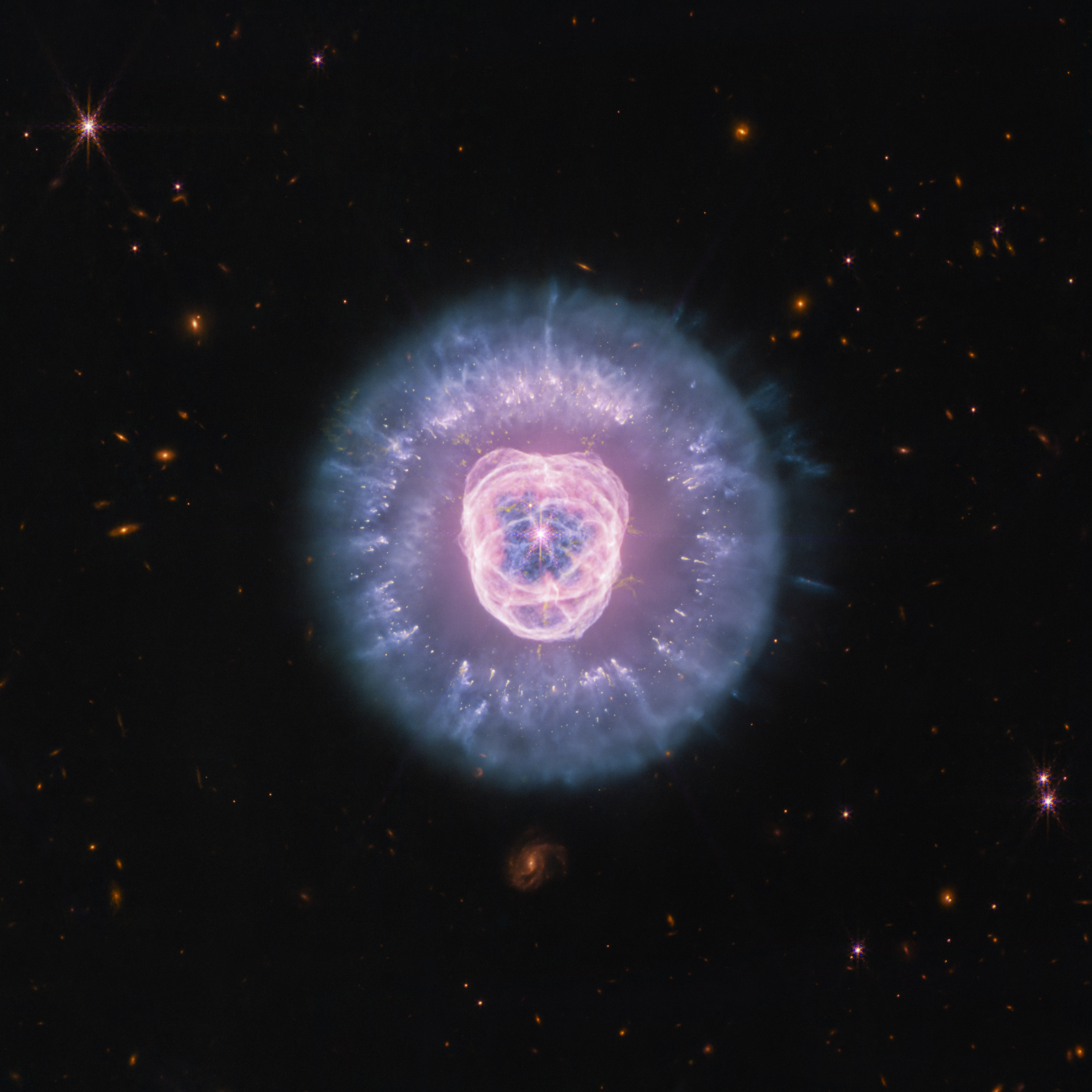
ManiThe Lion Nebula—cataloged as NGC 2392—does not roar with sound. It roars with structure. NASA’s James Webb Space Telescope has captured this planetary nebula using its NIRCam and MIRI instruments, which observe in near- and mid-infrared wavelengths. At the center, the remains of a dying star sculpt a luminous, lion-face-shaped bubble of ionized gas, wrapped in a ragged dust “mane.” The image is theatrical, almost mythic—but the drama is physical: stellar material, energized by the central remnant, has been shaped into nested layers and blazing contours. This is not a planet. It is a star’s aftermath, a vast, intricate farewell.
That distinction gives the picture its deeper charge. Webb is not merely producing beautiful cosmic wallpaper; it is turning hidden processes into evidence we can inspect. Infrared vision can reveal details that visible light alone may miss, helping scientists investigate how stars shed material and how those elements are redistributed into space—the raw ingredients for future stars, planets, and, ultimately, chemistry familiar to life. And there is a human dividend, too. NASA exploration drives advances in sensitive detectors, image processing, software, communications, and scientific collaboration. Those capabilities strengthen education, engineering, and the broader knowledge economy. So when the Lion Nebula appears to bare its teeth, it is also opening a door: from a dying star’s sculpted envelope to better tools, sharper questions, and a richer understanding of the cosmic environment that made our own world possible.
From Discovery to Disruption
At NASA, we see the culmination of our greatest scientific and engineering achievements. Their missions are a testament to the best of human knowledge and capability.
Lessons for Entrepreneurs from the Lion Nebula
Webb’s image of NGC 2392 shows how advanced tools can reveal hidden structure. Its NIRCam and MIRI instruments detect infrared light that ordinary cameras cannot see. Startups can apply the same principle: find valuable signals that competitors overlook.
- Build for multiple data layers. Combine different sensors, customer behaviors, and market signals. Like Webb’s instruments, each data source can reveal a different part of the problem. AI tools can then turn these layers into useful predictions.
- Design systems for extreme precision. Webb required careful calibration, testing, and coordination. Startups should use automated quality checks, strong measurement systems, and rapid experiments before scaling a product.
- Create modular technology. Webb’s instruments work together without being identical. Entrepreneurs can build platforms with flexible components, APIs, and plug-ins. This lowers development costs and helps products adapt to new markets.
- Turn complexity into a memorable story. The Lion Nebula’s face-shaped bubble makes difficult science understandable. Growth teams can use clear visualizations and compelling narratives to explain technical products, attract customers, and build trust.
The image also suggests a broader economic shift. As space-grade imaging, sensors, and data analysis become more accessible, they may improve climate monitoring, medical diagnostics, agriculture, robotics, and industrial inspection. The next major businesses may not sell raw data. They may sell interpretation—turning invisible patterns into decisions. Webb’s achievement therefore represents more than a scientific milestone. It points toward an economy in which precision, collaboration, and the ability to detect hidden value become decisive competitive advantages.
From the desk of a CISO
NASA isn’t just a representation of the best of the United States, it embodies our best aspirations as a species. It’s where we push the boundaries of what we thought was possible, and inspire generations to come.
The idea that NASA is a bloated government agency couldn’t be further from the truth. They operate with a tight budget and prioritize innovation and efficiency in all their work.
NASA has always been tasked with achieving big things on a small budget. Today, their budget represents less than half a percent of the total federal budget, yet they continue to make incredible scientific discoveries and technological advancements.
On my website, I make it a point to highlight stories like this to enrich my writing process and bring meaningful narratives to a wider audience. If you found this article engaging, you might enjoy other stories in the Science section or Small Business section.
To check the original story Click here
Learn Something New
Here are some more Space and Science learning resources Learning Resources for Educators.
NASA-V3